
The LHC provides CMS with millions of collisions each second, and a wealth of physics data is obtained from the proton-proton interactions. In order to record all these data for analyses, all CMS sub-detectors have to be performing optimally. If you…
News
|
achintya |
Physics
CMS has presented a rich variety of results at the Electroweak Interactions and Unified Theories sessions of the Rencontres de Moriond conference in La Thuile, Italy. Links to the Physics Analysis Summaries (PAS) from CMS made public in the last…
|
achintya |
Physics
At a CERN seminar today, CMS presented results for the search for new physics in the decay of Bs and B0 mesons to two muons, taking into account all of the 4.9 fb−1 of data collected in 2011. The results — upper limits of 7.7 x 10⁻⁹ (Bs) and 1.8 x…
|
lucas |
Physics
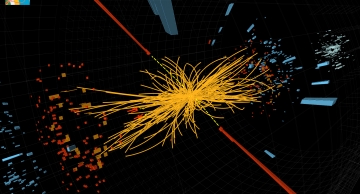
This week the CMS collaboration will publish the results of its search for the Higgs boson that were presented at CERN in December 2011 [1].
Nine papers will be submitted for publication using the entire data sample of proton-proton collisions…
|
incandel |
Physics
CMS is organizing a Workshop entitled Perspectives on Physics and on CMS at Very High Luminosity, HL-LHC which will take place in the Ukrainian city of Alushta in the Crimea, 28-31 May, 2012. JINR (Dubna) will serve as a host. Alushta is a scenic…
|
achintya |
Physics
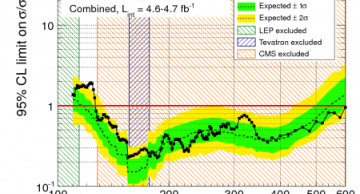
“If you remember, Mark Twain once said, ‘There are three kinds of lies: lies, damned lies, and statistics.’ If you use statistics in an improper way, you could get pretty much any result,” says Greg Landsberg, CMS’s new physics coordinator. “The…
|
pivarski |
Physics
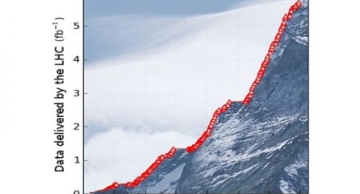
Data are the currency of physics. As data accumulate, measurement uncertainty ranges narrow up to a certain point, increasing the potential for discoveries and making non-observations more stringent, with more far-reaching consequences. In collider…
|
gritsan |
Physics
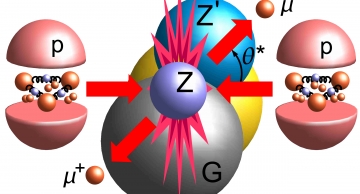
The source of energy for most of the life on our planet originates from proton-proton collisions at the core of the Sun, which occur at an energy (or temperature) about a billion times less than the collision energy of the LHC. Due to emission of…
|
lincoln |
Physics
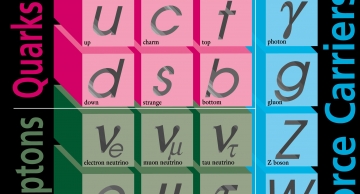
Grab a can of soda, shake it thoroughly, and open it up. What do you get? It’s an explosion of fizz. A similar phenomenon in the subatomic world might help us probe the nature of fundamental particles.
Scientists have spent centuries searching for…
|
achintya |
Physics
Read the paper: EXO-11-005
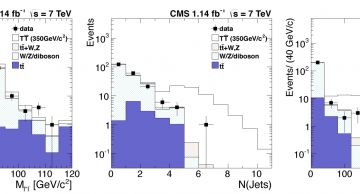
In this Letter, CMS describes a search for a kind of fourth-generation T quark with charge 2/3. The search for T-antiT pairs was performed in events that had a pair of oppositely charged leptons (l+l−) as well as an…
|
agiamman |
Physics
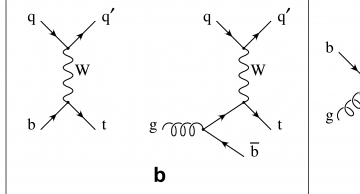
The Top quark is the heaviest of the six quarks of the Standard Model and was discovered only 16 years ago by the Tevatron experiments at Fermilab. In addition to the usual production of Top-AntiTop pairs in accordance with quantum chromodynamics (…
|
achintya |
Physics
Read the paper: SUS-11-003
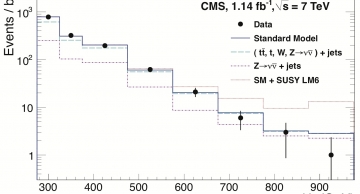
The analysis shows no excess of events over the Standard Model expectations. As a result, exclusion limits were placed on searches for squarks and gluinos in the Constrained Minimal Supersymmetric extension of the Standard…