
CMS investigates charm-quark jets in heavy-ion collisions and finds no evidence of additional radiation inside the dead cone
When lead ions collide at the Large Hadron Collider, they create an extreme state of matter known as the quark-gluon plasma (QGP), a hot and dense medium similar to the one that filled the Universe shortly after the Big Bang. Jets — collimated sprays of particles produced by energetic quarks and gluons — provide one of the most powerful tools to study this medium.
A unique feature of heavy quarks is the so-called dead-cone effect, which suppresses gluon radiation within a cone around their direction of motion. This phenomenon has been observed in proton-proton collisions. In heavy-ion collisions, however, the surrounding QGP may induce additional radiation that could partially fill this radiation-free region.
Using lead-lead collision data collected by the CMS experiment in 2018, physicists studied jets initiated by a charm quark and compared them with inclusive jets (dominated by light-quark and gluon jets ). The goal was to determine whether the QGP modifies the characteristic radiation pattern associated with charm quarks.
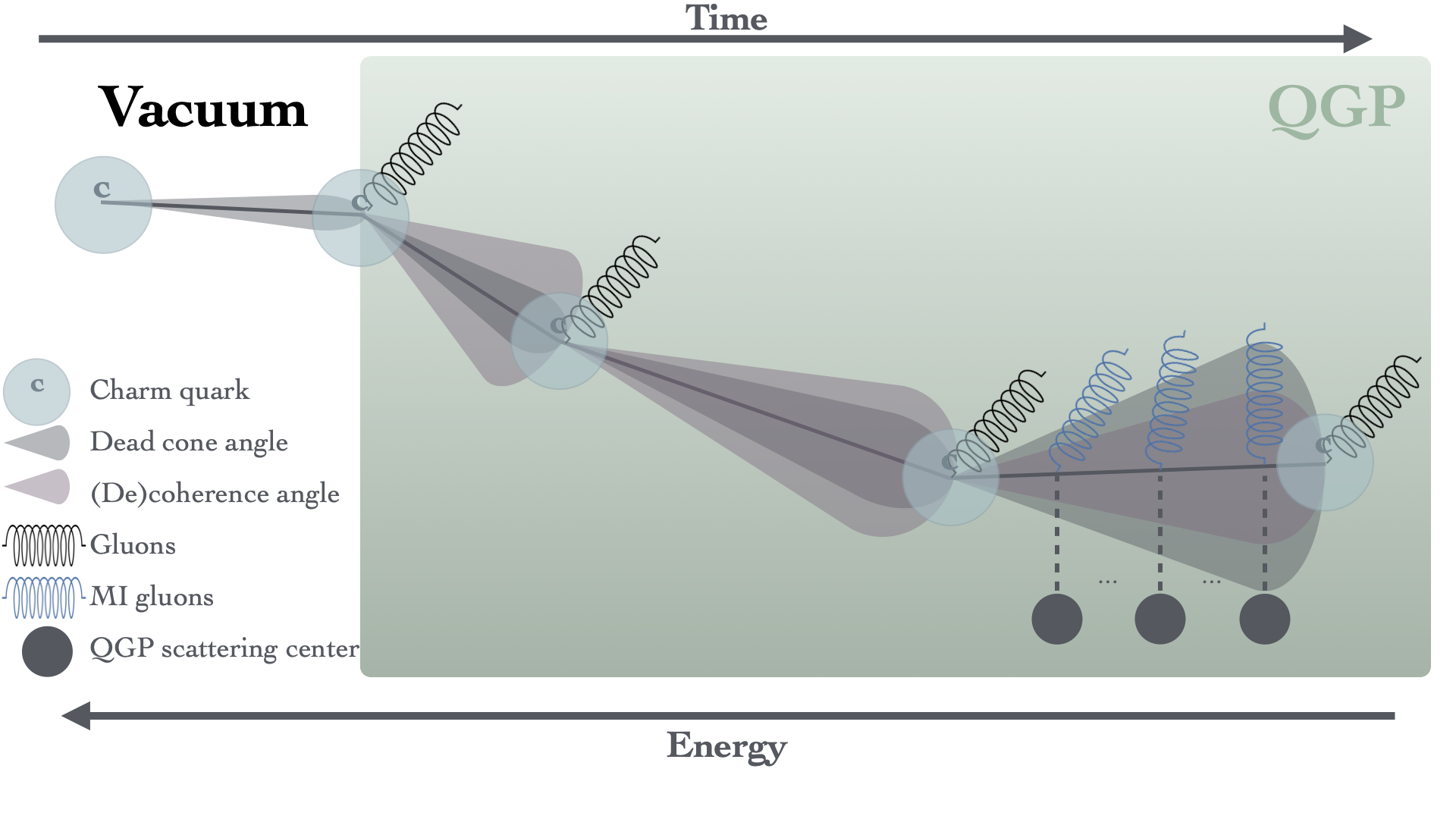
Figure 1: Illustration of a charm quark propagating through the quark-gluon plasma. The gray cone represents the dead cone, where gluon radiation is suppressed. The pink cone illustrates the characteristic resolution scale of the medium. Depending on the relative size of these two cones (which changes with each step as energy is dissipated), the medium may or may not induce additional radiation inside the dead cone.
Figure 1 illustrates the propagation of a charm quark through the QGP. In vacuum, gluon radiation is suppressed inside the dead cone surrounding the charm quark. In a dense medium, an additional scale appears that determines whether the QGP can interact with the internal structure of the jet. If so, additional radiation induced by the QGP may appear inside the dead cone. Otherwise, the dead cone remains essentially vacant.
To investigate this question experimentally, CMS measured the angular distribution of splittings within jets. Figure 2 compares the distributions observed for D0 meson-tagged jets and inclusive jets in lead-lead collisions and contrasts them with those measured previously. A hint of suppression at small-angles (corresponding to larger values of ln(1/θ)) is observed for D0-tagged jets relative to inclusive jets, consistent with the dead-cone effect previously measured in proton-proton collisions.
The difference between charm-tagged and inclusive jets remains consistent within experimental uncertainties when comparing lead-lead and proton-proton collisions, indicating that any medium-induced filling of the dead cone is limited within the current experimental sensitivity. This constitutes the first experimental test of how the dead-cone effect interacts with the quark-gluon plasma.
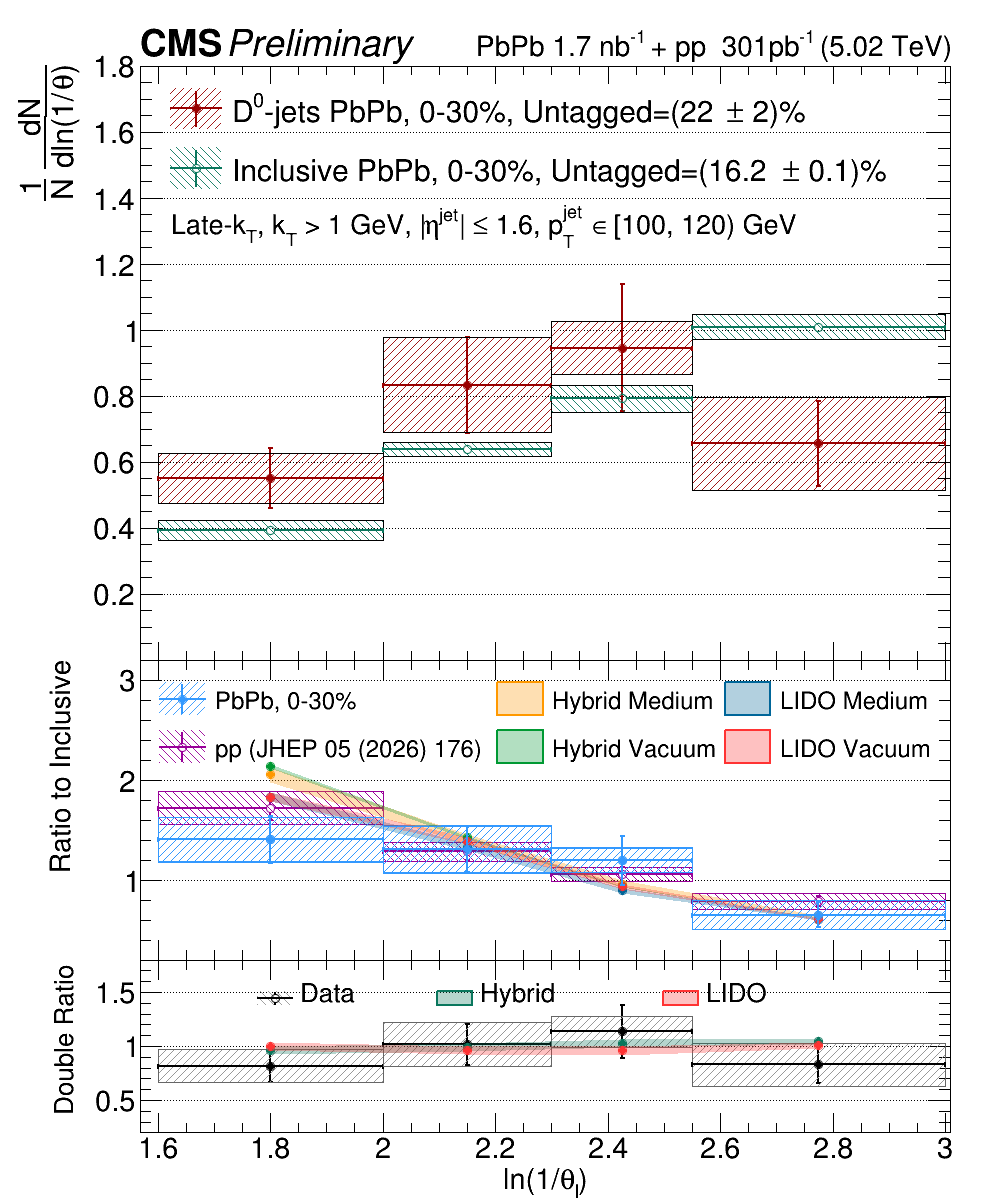
Figure 2: Angular distributions of last energetic splitting (kT > 1 GeV), called “D0-tagged and inclusive jets in lead-lead collisions at 5.02 TeV. The lower panel shows the ratio between lead-lead (blue) and proton-proton (purple) measurements. The data are consistent, with no significant modification of the charm-quark dead cone in the quark-gluon plasma.
Future measurements of jets initiated by beauty quarks, are expected to possess a larger dead cone, will provide an even more stringent test of theoretical predictions and may reveal a regime where medium-induced radiation becomes directly visible inside the dead-cone region.
As Lorenzo Frosina, PhD student at Sapienza Università di Roma, explains: “For many years, studies of flavor dependence in heavy-ion collisions relied primarily on less detailed inclusive observables, where jets were treated as monolithic objects. This measurement is the first direct test of the dead-cone effect in lead-lead collisions through the evolution of the internal structure of the charm-jet parton shower. The observation of a similar suppression of small-angle splittings in both proton-proton and lead-lead collisions suggests that medium-induced radiation does not significantly fill the charm-quark dead cone, in line with theoretical expectations.”
Written by: Lorenzo Frosina, Leticia Cunqueiro Mendez, for the CMS Collaboration
Edited by: Andrés G. Delannoy
Read more about these results:
-
CMS Physics Analysis Summary (HIN-25-013): "Study of the charm-quark dead cone in heavy-ion collisions"
-
@CMSExperiment on social media: Bluesky - Facebook - Twitter - Instagram - LinkedIn - TikTok - YouTube