
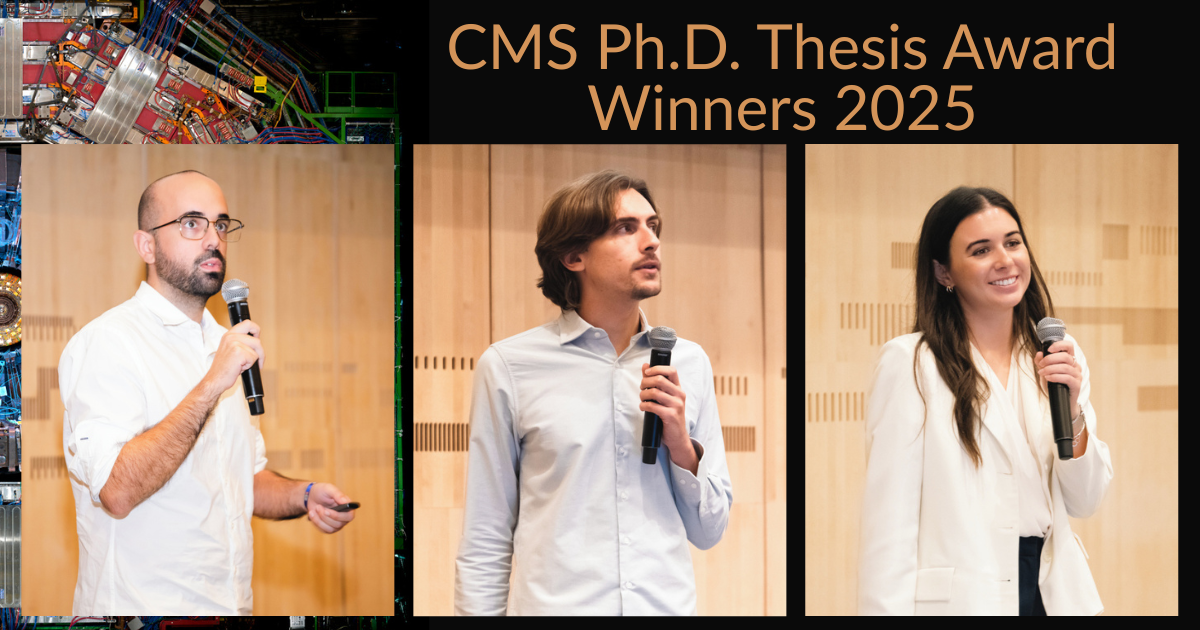
The CMS Collaboration congratulates the winners of the 2025 CMS PhD Thesis Award: Laurdis Jeppe, Elena Vernazza, and Carlos Vico Villalba.
The award celebrates outstanding theses from the CMS collaboration that have a significant impact on the CMS experiment and in the broader field. They are pieces of work that show unparalleled creativity and scientific excellence.
With 25 unique nominations of theses defended between the 1st of November 2024 and the 31st of October 2025 to review, the CMS Thesis Awards Committee remained impressed by the breadth and quality of all the work. The nominations spanned almost all areas of CMS physics, many also containing significant detector work, and clearly demonstrated hard work, boundless passion for physics, ingenuity, and talent.
QUOTE QUOTE
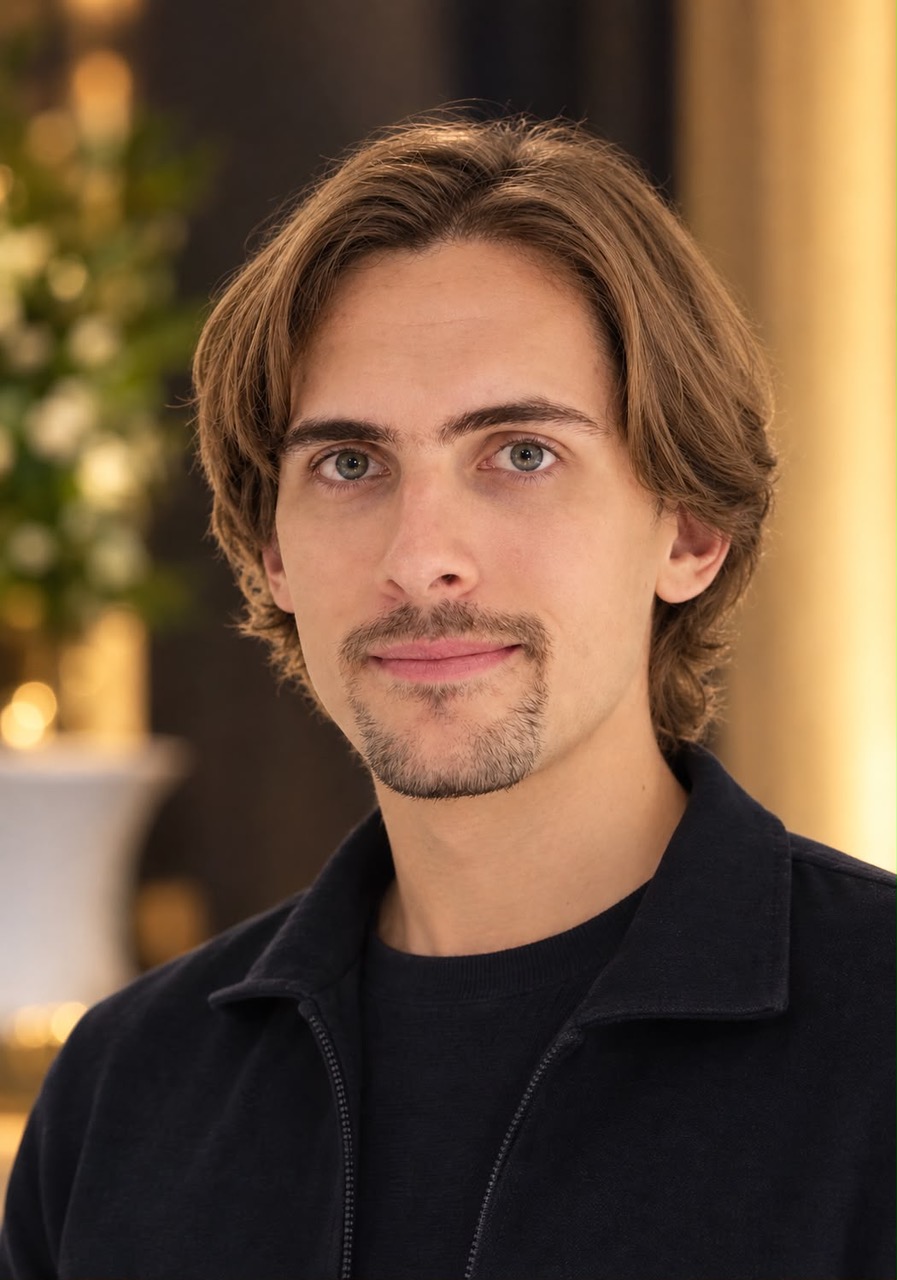 Laurids Jeppe (Hamburg, Germany)
Measurement of the inclusive 𝑡𝑡̅ production cross section and search for additional scalars in 𝑡𝑡̅ final states at CMS
My thesis focuses on the top quark, the heaviest known elementary particle, and on how it is produced in pairs (tt̄) in proton-proton collisions at the LHC. I first measured the inclusive tt̄ production cross section at the record collision energy of 13.6 TeV, using only the first data of Run 3. With a precision of 3.4%, it was the first physics result of Run 3 and confirmed the excellent quality of the new data. In a second analysis, I searched the full Run 2 dataset for new heavy particles decaying into top quark pairs. There, we observed an unexpected excess of events close to the tt̄ production threshold, with spin correlations consistent with a pseudoscalar state. It is compatible with a tt̄ quasi-bound state, which had never been observed before, with a significance above five standard deviations. Because other explanations cannot yet be excluded, I also interpreted the excess in terms of additional scalar and pseudoscalar bosons and axion-like particles, and derived constraints on their couplings to the top quark. I am excited to see what this excess will teach us in the coming years!
 Elena Vernazza (École Polytechnique, France)
Characterisation of the HGCROC3 read-out chip for the future HGCAL, innovative calibration techniques at trigger level and study of the ZZ/ZH→bbττ processes with the CMS detector at the LHC
My thesis focuses on expanding the physics reach of the CMS experiment at the Large Hadron Collider (LHC) through the analysis of collision data and the development of new detector technologies. I first analysed the full Run-2 dataset, searching for the production of pairs of Z bosons (ZZ) and of a Z boson together with a Higgs boson (ZH), in a challenging final state involving two bottom quarks (b) and two tau leptons (τ). This analysis served a dual purpose: validating the analysis techniques used to search for Higgs boson pair production in the same final state, and searching for new heavy particles with masses between 200 GeV and 6 TeV. Observing such rare phenomena also requires continuous improvements in detector performance and precision. To this end, I developed a machine-learning method to improve the energy resolution and selection efficiency of the CMS Level-1 trigger system, which identifies in real time the most interesting collisions to be recorded for analysis. Looking further ahead to the High-Luminosity LHC, I contributed to the characterisation of a new electronic chip for the future High-Granularity Calorimeter. I tested its radiation hardness and identified vulnerabilities that guided improvements to its design. Together, these three projects tackle different aspects of the same challenge: maximizing the discovery potential of CMS in the onging quest to uncover new physics.
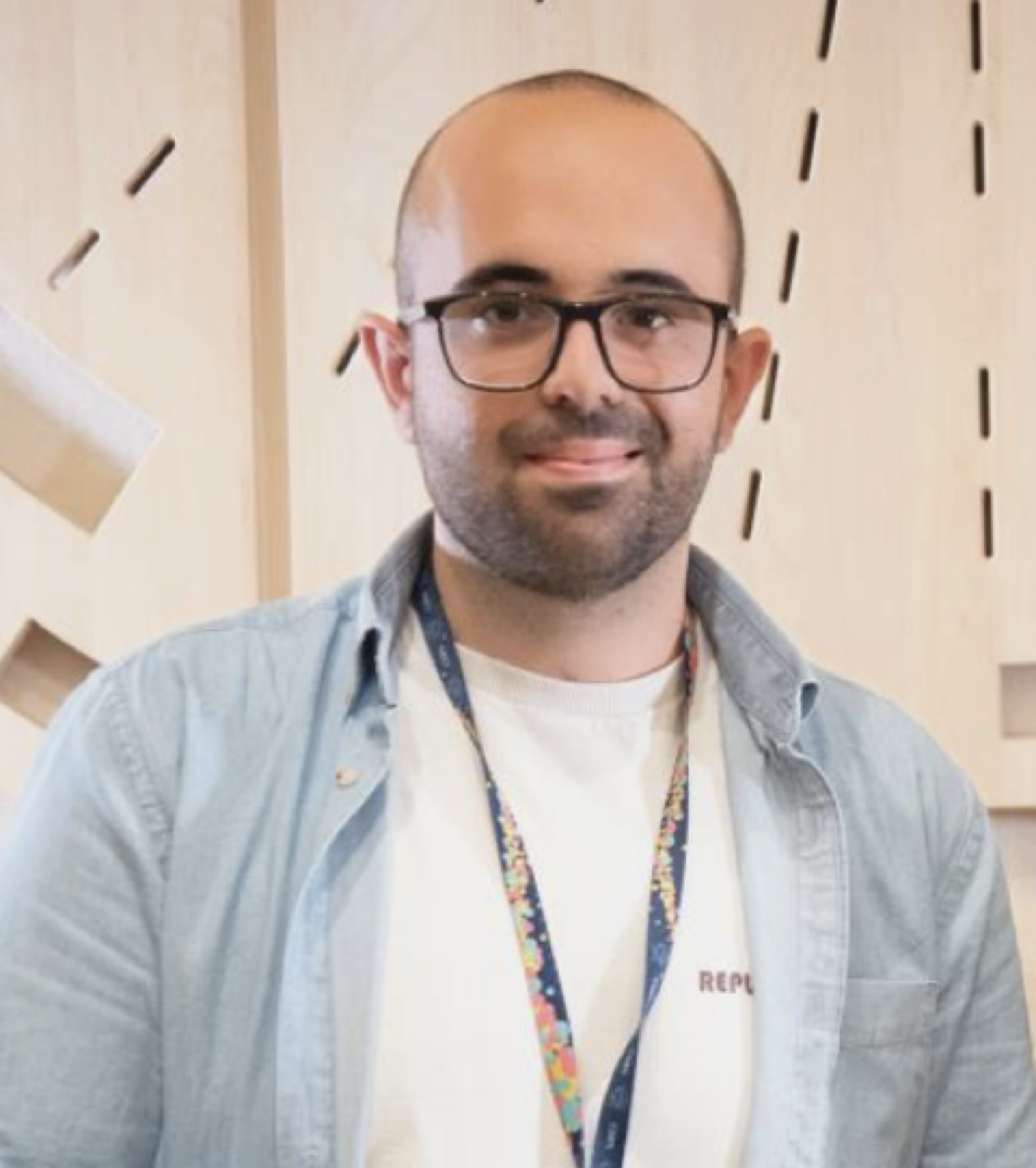 Carlos Vico Villalba (University of Oviedo, Spain)
Study of top quark processes and L1 trigger in the Run 3 of the LHC
A major part of my PhD research focused on measuring the production rates of top quarks in association with W bosons (ttW), as well as the simultaneous production of W and Z bosons (WZ). These precision measurements provide important tests of the Standard Model, our current best description of fundamental particles and their interactions, and help us investigate potential discrepancies between theoretical predictions and experimental observations. My work also contributed to improving particle identification and data analysis techniques, including methods for identifying muons and electrons that have since been adopted in many Run 3 CMS analyses. In addition, I studied how the performance of the CMS muon detectors would be affected under the harsh operation conditions expected at the High-Luminosity LHC. Finally, I developed new algorithms to identify collision events in which high-energy muons produce shower-like signatures in the barrel muon detectors. Together, these contributions help prepare the CMS experiment for its next phase.

Further Reading:
The 2024 CMS PhD Thesis Award Winners