
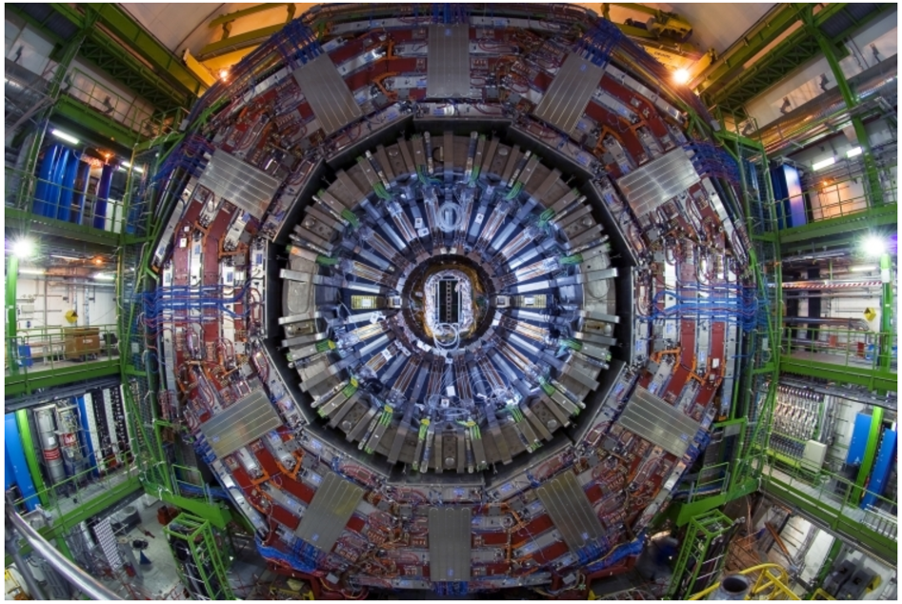
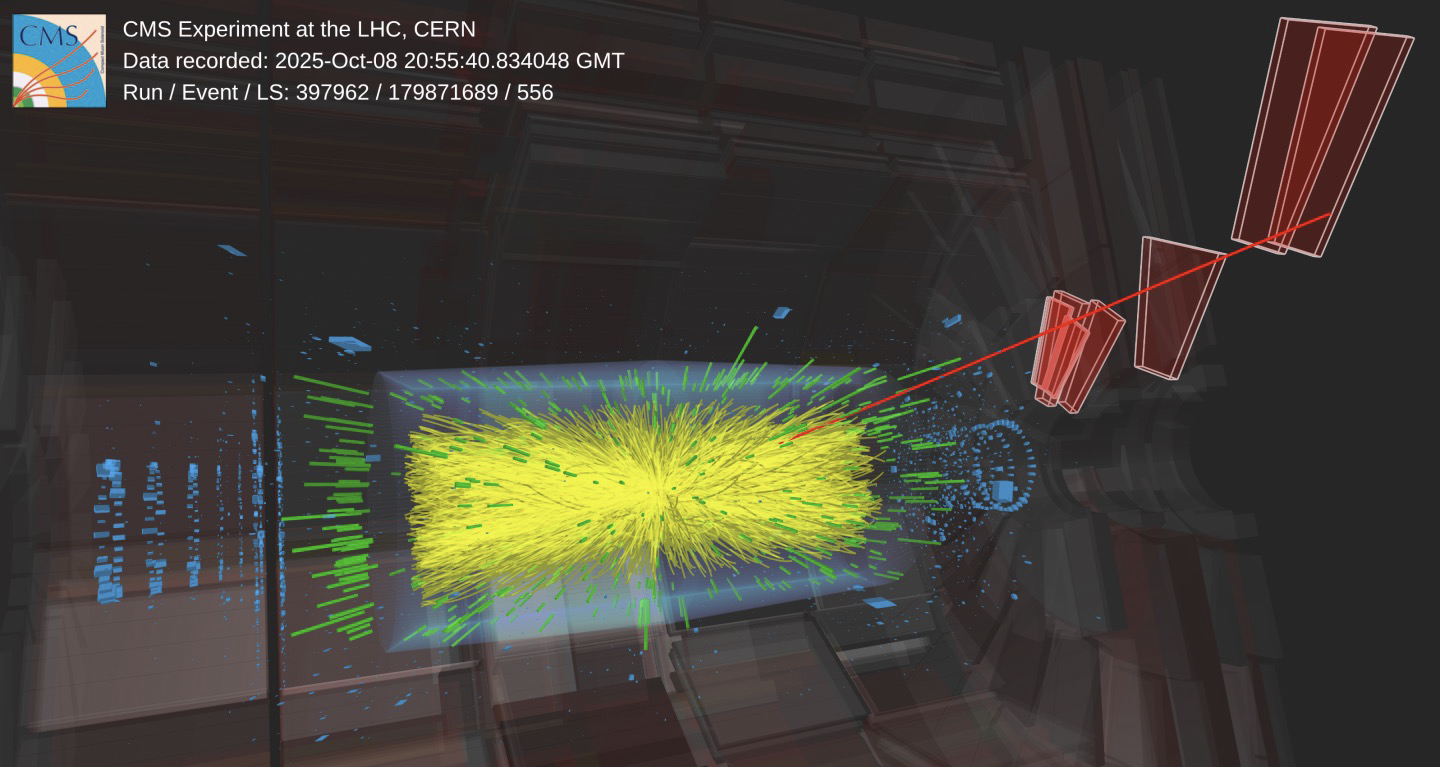
A special test run, with more than twice as many near-simultaneous collisions as usual, allowed CMS to test new methods of tracking and identifying particles, years before the upgraded High-Luminosity LHC comes online.
For a few days during 2025, the LHC ran a dedicated study, aiming to recreate collision conditions closer to those expected at the future High-Luminosity LHC (HL-LHC). CMS researchers seized the opportunity to check whether their current software for tracking, identifying, and “reconstructing” particles – and a new machine-learning approach shaping tomorrow's – can cope with the intense conditions expected at the HL-LHC. The result: CMS's toolkit holds up remarkably well.
In order to smash protons into each other, the LHC crosses bunches of around a hundred-billion protons each. Every bunch crossing is a crowded scene, with dozens of proton-proton collisions overlapping at once, a challenge known as pileup. Each collision leaves its own trace, making it harder to isolate the interaction of interest. At the HL-LHC, this problem intensifies: 140 to 200 simultaneous interactions are expected, versus the around 65 in Run 3.
To emulate those conditions, the LHC was filled with fewer proton bunches than usual, so that whilst each crossing looked as crowded as an HL-LHC collision, the overall collision rate, and radiation dose to the detector, stayed low. This let the LHC reach roughly 150 simultaneous interactions per crossing, without exposing today's detector to conditions it wasn't built to sustain. The study focused on the barrel region, whose calorimeter design carries over largely unchanged into the HL-LHC era, unlike the endcaps, which will gain an entirely new detector.
Two methods were used to turn raw detector signals into identified particles. Particle-flow (PF) has been CMS's workhorse for over a decade: a carefully built rulebook combining information from the tracker, calorimeters, and muon system. The newer Machine-Learning Particle-Flow (MLPF) instead lets a single machine-learning model learn directly from simulation how particles show up in the detector. Earlier tests showed that MLPF can match, or even improve over, standard PF, while running much faster on modern GPUs. Regardless of which reconstruction algorithm is used, the impact of pileup is further reduced by Pileup Per Particle Identification (PUPPI), which assigns each reconstructed particle a score reflecting how likely it is to originate from the primary collision rather than from pileup interactions, and weights its contribution accordingly.
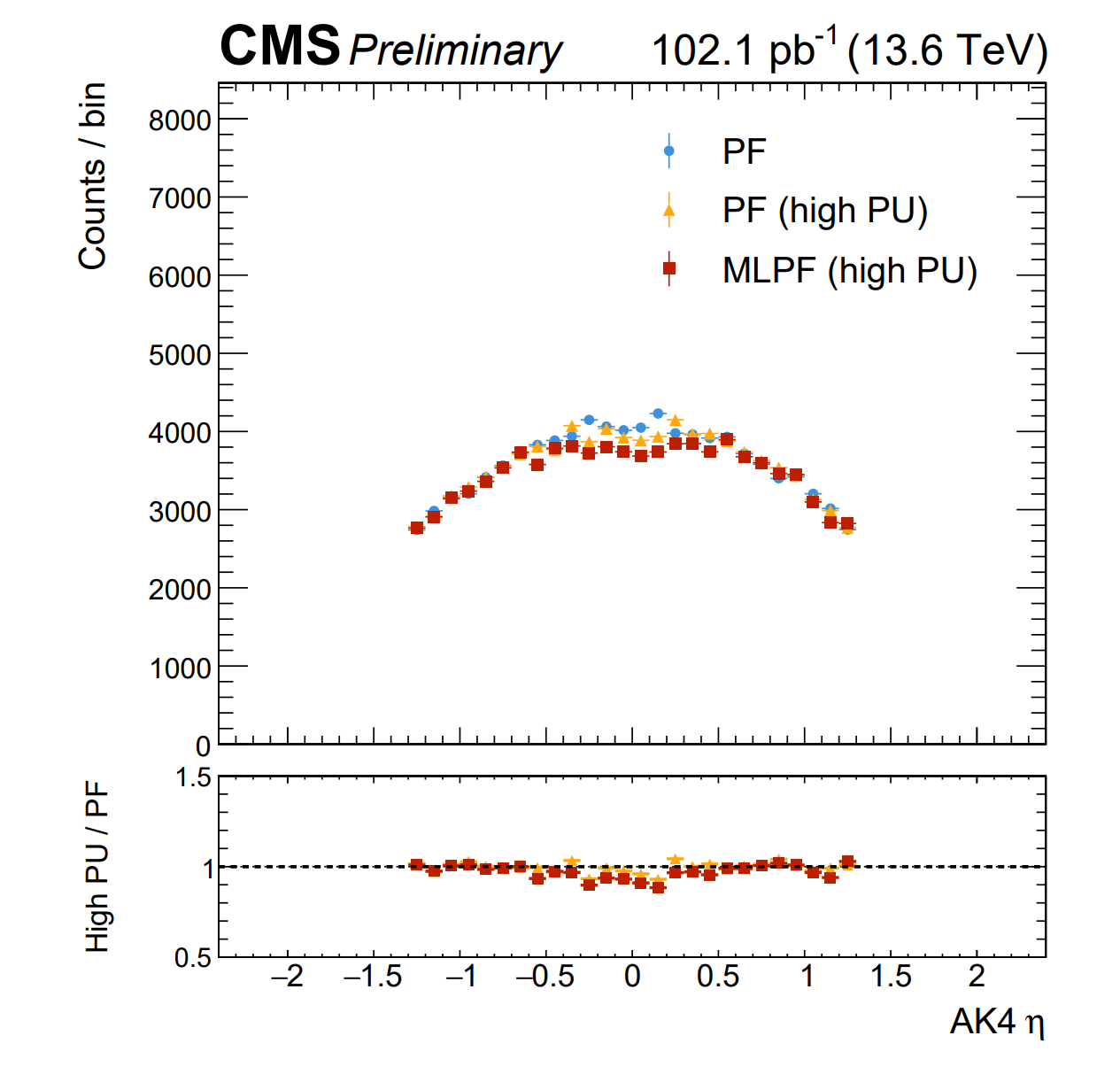
Above: PF and MLPF reconstruct jets (collimated sprays of particles) similarly under different pileup conditions.
The key result is reassuring: jets (collimated sprays of particles) and their energies came out consistent between the high-pileup and normal data taking, and between PF and MLPF, with no special treatment for the busier environment. One caveat: MLPF was tested exactly as trained on normal conditions, without retraining for this extreme pileup. Under that stress test, MLPF missed slightly more faint, low-energy particles than PF, leaning more on harder, higher-energy ones; yet the total reconstructed energy per event matched either way.
“Previewing the future operating conditions of our detector presents a really exciting opportunity, as we get to both evaluate the efficacy of our algorithms and lay the groundwork for the next decade of collider physics at CERN,” says Valdis Slokenbergs, PhD student at Texas Tech University.
Taken together, these results are an encouraging signal years ahead of schedule: CMS’s particle-flow toolchain, standard PF, MLPF, and PUPPI, holds up reasonably well even pushed towards HL-LHC-like conditions. The handful of places where MLPF diverged from PF point directly to what a future retraining should target. Combined with upcoming studies of the endcaps, where the new detector will reshape reconstruction entirely, this early glimpse leaves CMS better prepared for the upcoming HL-LHC.
Written by: Mohamed Darwish and Andreas Hinzmann, for the CMS Collaboration
Edited by: Muhammad Ansar Iqbal
Read more about these results:
-
CMS Detector Performance Note (DP-26-111): "Performance of jet, missing transverse momentum, and (machine-learned) particle flow reconstruction in pp collision data with more than 100 pileup interactions at the CMS experiment"
-
@CMSExperiment on social media: Bluesky - Facebook - Instagram - LinkedIn - TikTok - Twitter/X - YouTube