
A new boosted jet technique, powered by machine learning, gives CMS its most sensitive search for Higgs bosons breaking apart into never-before-seen particles.
Some theories predict that new light particles associated with the Higgs boson could provide a bridge between ordinary matter and dark matter. CMS has recently completed a search for particle collisions in which a Higgs boson spontaneously decays into two undiscovered particles, each of which decays quickly into a pair of beauty quarks. Using the complete 2016–2018 dataset, CMS found no convincing evidence for these new particles. The results show that no more than 10% of Higgs bosons could decay in this way.
Achieving this level of sensitivity required three major advances. First, CMS focused on rare, highly energetic (“boosted”) Higgs bosons. Quarks produce narrow sprays of particles known as jets, and in these events, the four beauty quarks travel so close together that their sprays merge into a single large jet. Second, the search targeted five different Higgs boson production modes, increasing the number of potential signal events. Finally, advanced machine-learning techniques were used to identify these merged jets by revealing their internal structure.
"This analysis combines all major Higgs production modes with modern machine learning and signal extraction methods to tackle one of CMS's most challenging signatures", says Hichem Bouchamaoui, a PhD student at Princeton University.
Machine Learning Untangles Complex Jets
Only about 1% of Higgs bosons have enough momentum for all four beauty quarks to cluster into one jet. These boosted bosons are easier for CMS to see, but distinguishing such jets from the large number of similar, ordinary jets required a new approach. CMS deployed ParticleNet, a machine learning tool that discovers patterns in jets, much like image-recognition software identifies objects in photos. Trained on the internal jet structure, it can distinguish genuine four-beauty-quark jets from other more common jets and extract information from both the full jet and the smaller particle groups inside it.
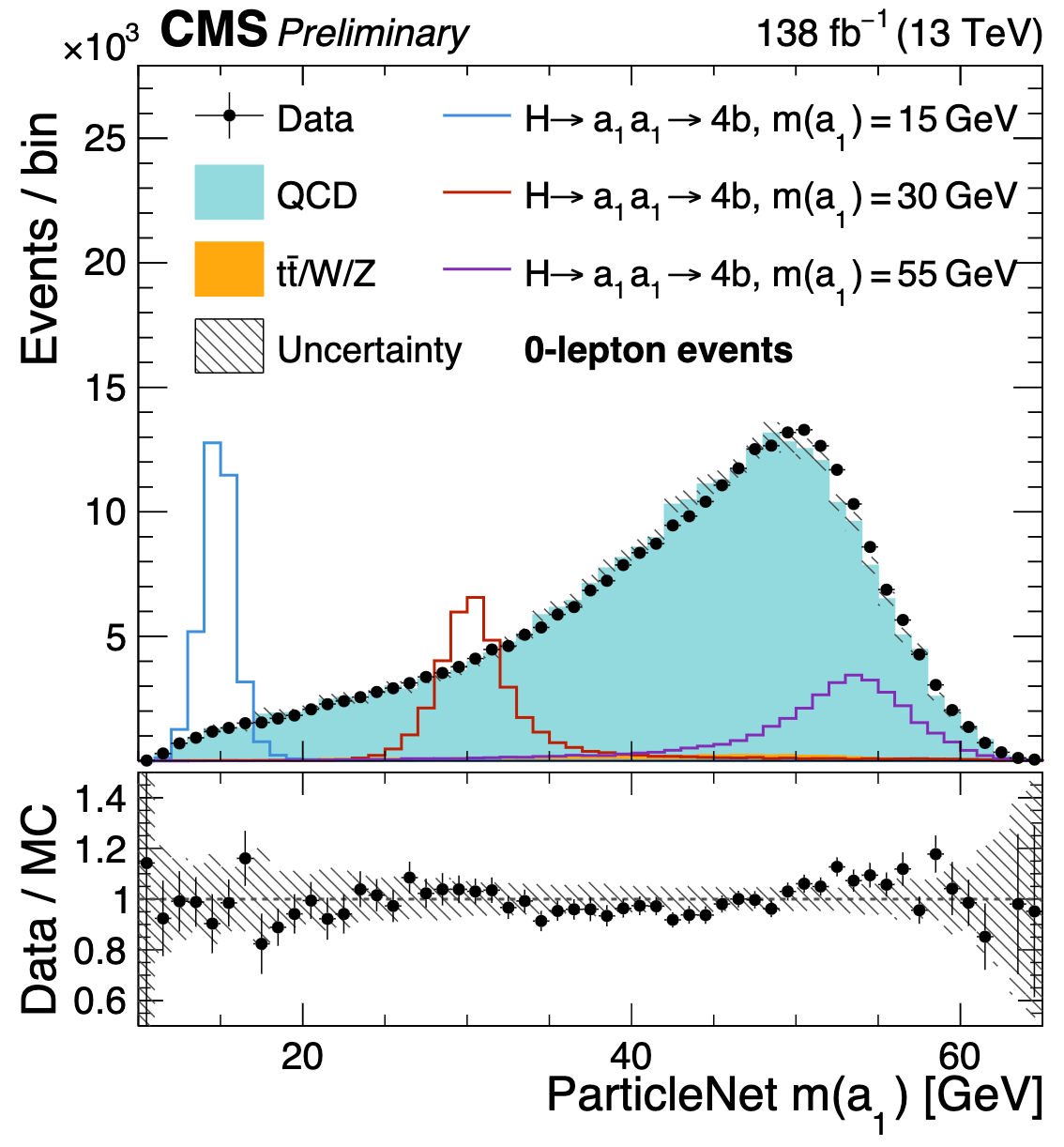
Above: Distribution of the possible new-particle masses produced in Higgs boson decays, as reconstructed by ParticleNet. The black points show CMS collision data collected during Run 2, the light-blue shading shows the expected contribution from ordinary processes and the coloured lines show hypothetical Higgs events with three different new-particle masses.
Tightening the Net on New Physics
CMS found no strong evidence for new particles, but the results show that if such Higgs boson decays occur in nature, they must be quite rare. Depending on the mass of the new particle, at most 0.13% to 9.4% of Higgs bosons could decay through this channel. These constraints are up to ten times stronger than those from previous searches.
“The absence of a signal is itself an important result, helping to shape the next generation of theories and experiments”, says Siddhesh Sawant, a postdoctoral researcher at Baylor University.
A small excess of events consistent with a new particle with a mass around 45 GeV was found in the data, but it could be a simple statistical fluctuation, and only larger datasets will be able to confirm or rule out the existence of this particle.
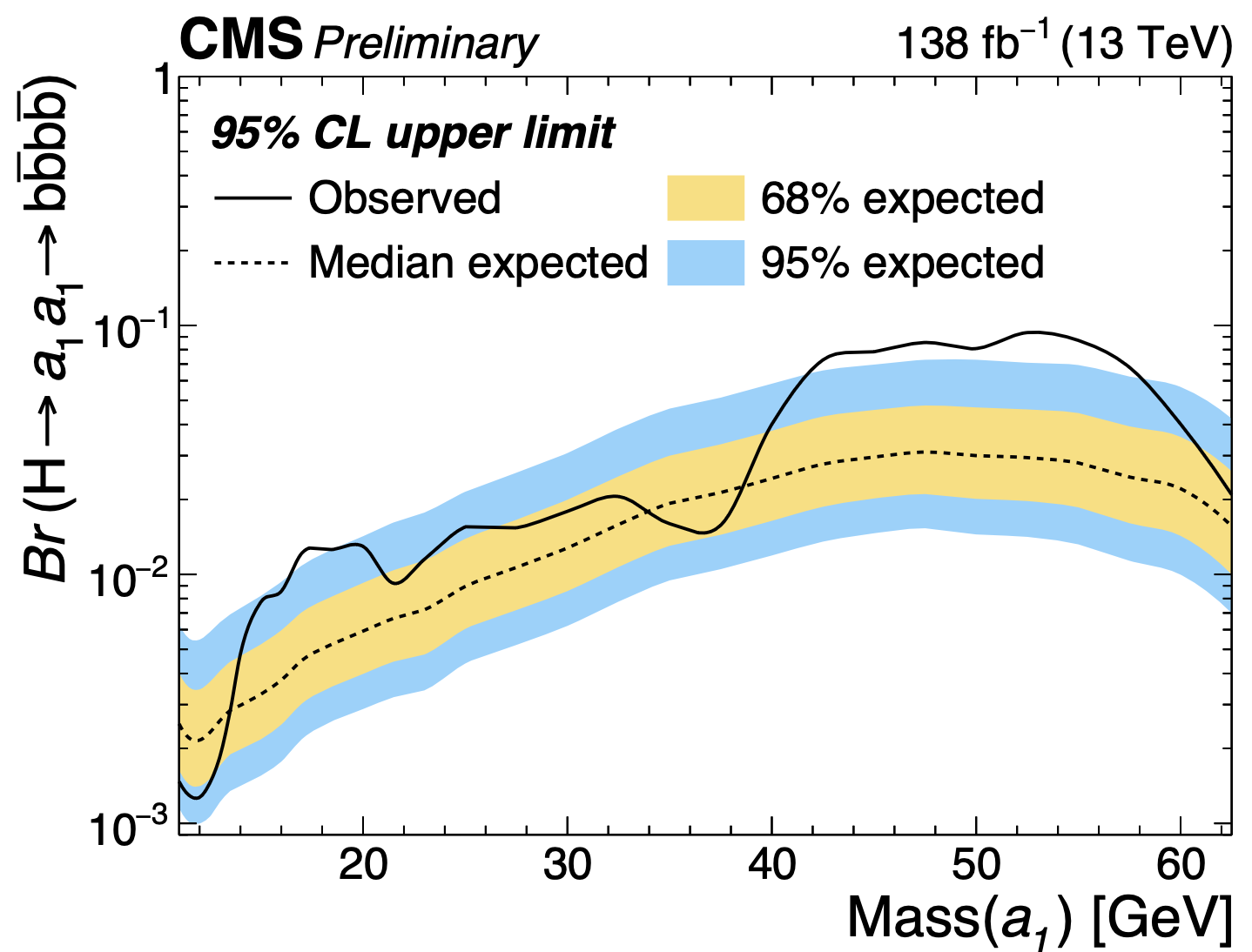
Above: Observed and expected upper limits set by CMS on the fraction of Higgs bosons that decay into two new particles, which then split into four beauty quarks.
These results close off more places that new particles could be hiding, and further constrain theories that link new physics to the Higgs boson. But the hunt is far from over. With boosted Higgs decay techniques, advanced machine-learning techniques, and steadily increasing datasets, CMS is well positioned to discover new phenomena during LHC Run 3 and future high-luminosity operation.
Written by: Mohamed Darwish, Yihui Lai and Andrew Brinkerhoff for the CMS Collaboration
Edited by: Haifa Rejeb Sfar
Read more about these results: