
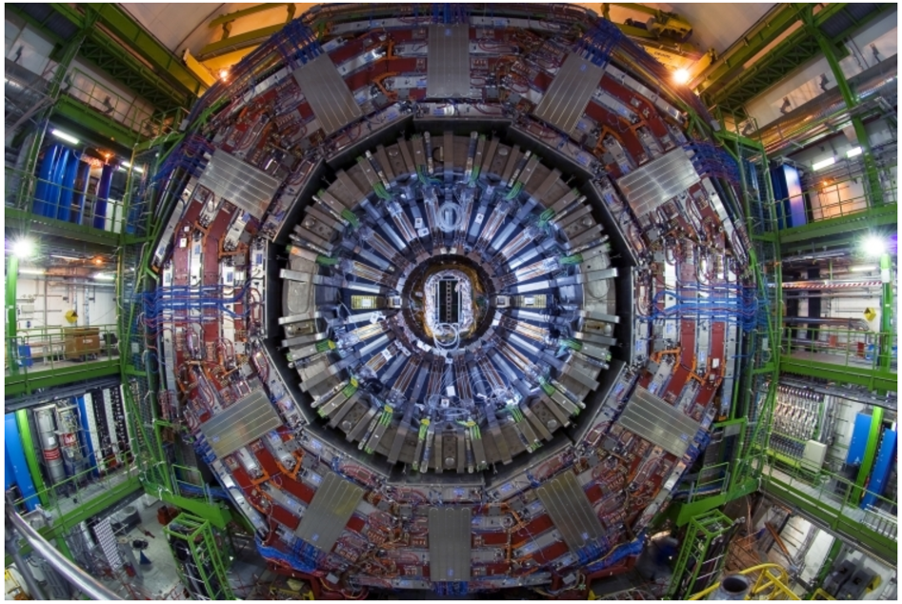
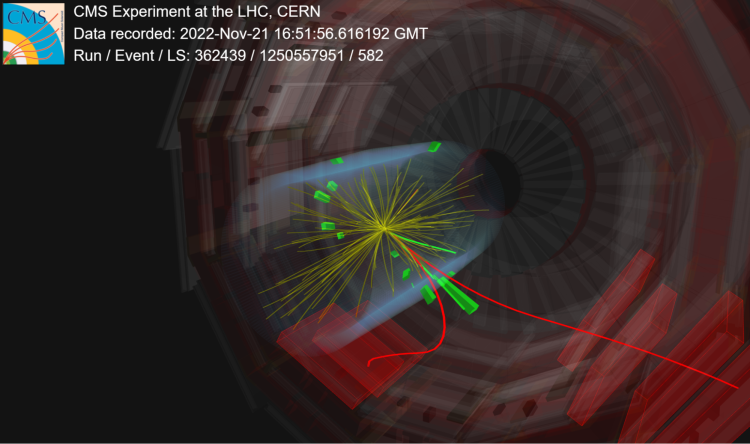
The CMS experiment reports the first observation of the rare decay of an eta meson to two muons and two electrons.
The CMS detector was originally built to discover the Higgs boson and search for heavy particles that could transform our understanding of the makeup of the universe. Yet this remarkably versatile detector is also capable of making discoveries in a very different realm, related to properties of light particles that we already know exist. Building on the successful observation of the η (read "eta") meson decay into four muons in 2023, the CMS experiment has now observed the rare η meson decay into two muons and two electrons, as illustrated below.
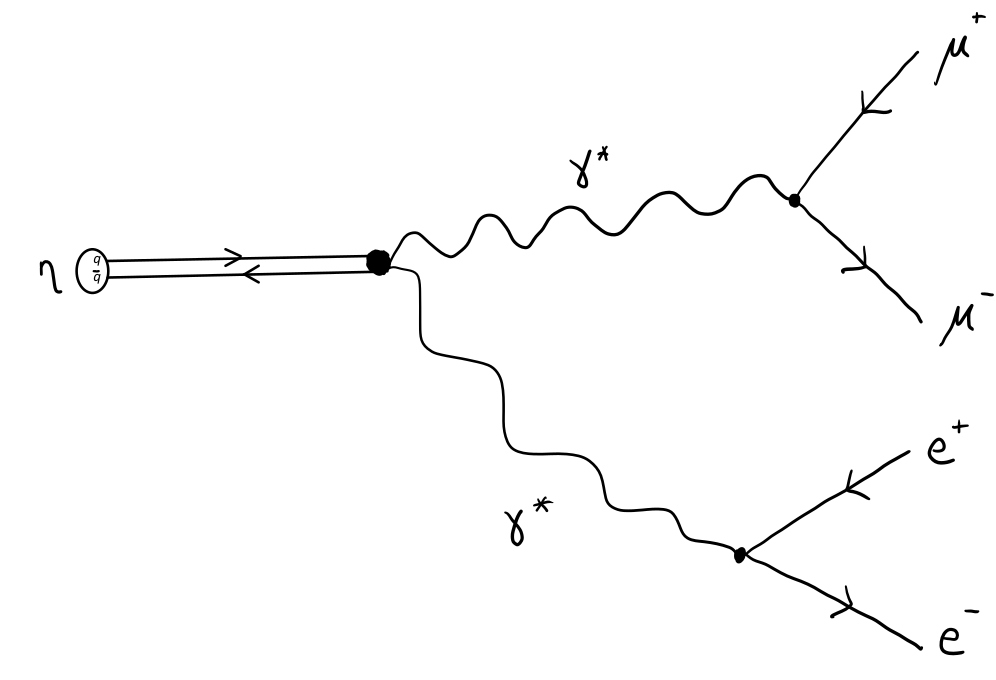
Above: Schematic (Feynman diagram) for the decay of an η meson to two muons and two electrons, mediated by two “virtual” photons.
Mesons are composite particles made up of one quark and one antiquark, bound together by the strong nuclear force. They can be found in cosmic rays, which result from the collision of high-energy particles from outer space with atoms in the upper atmosphere. Mesons are also copiously produced in particle colliders like the LHC. The most abundant mesons-the ones that are easiest to produce in collisions-are the lightest, made up of the lightest three quark flavors: up, down, and strange. The mesons composed from these flavors include pions, kaons, and two more mesons dubbed η and η' (read "eta prime"). The lighter of these two, η, is the one that CMS has thus far managed to put under the metaphorical microscope.
All mesons are unstable, surviving for less than a ten-millionth of a second before decaying into other particles. But what are those other particles that they decay into? The answer to this important question is provided by the underlying theory: the Standard Model of particle physics.
The Standard Model predicts that the η meson should decay into a muon pair and an electron pair only around two times out of every one million decays. So this is a very rare process that we are trying to observe. Luckily, CMS has some tools that allow us to see such rare processes.
One of these novel techniques is data parking. Typically, since the trigger system quickly decides which events to keep, many are discarded due to limited computing resources, even though some may contain interesting physics. By having the option of storing or “parking” raw data for later analysis instead of processing it immediately, we can capture more potentially valuable events without risking overloading the system. In Run 3, it turned out that CMS had enough computing resources that even the parked events didn't have to wait to be reconstructed.
Many events with low-energy muons and electrons were saved that otherwise would have had to be discarded. These events are further filtered by strict selections to make sure we're really seeing this decay and not some background process. The resulting spectrum of invariant mass (the mass of the particle reconstructed from the two muons and two electrons) is shown below. A large and unmistakable peak appears in the data right at the mass of the eta meson, 0.55 GeV, indicating that we've observed exactly what we were looking for; these muons and electrons are extremely likely to have come from the decay of the η meson!
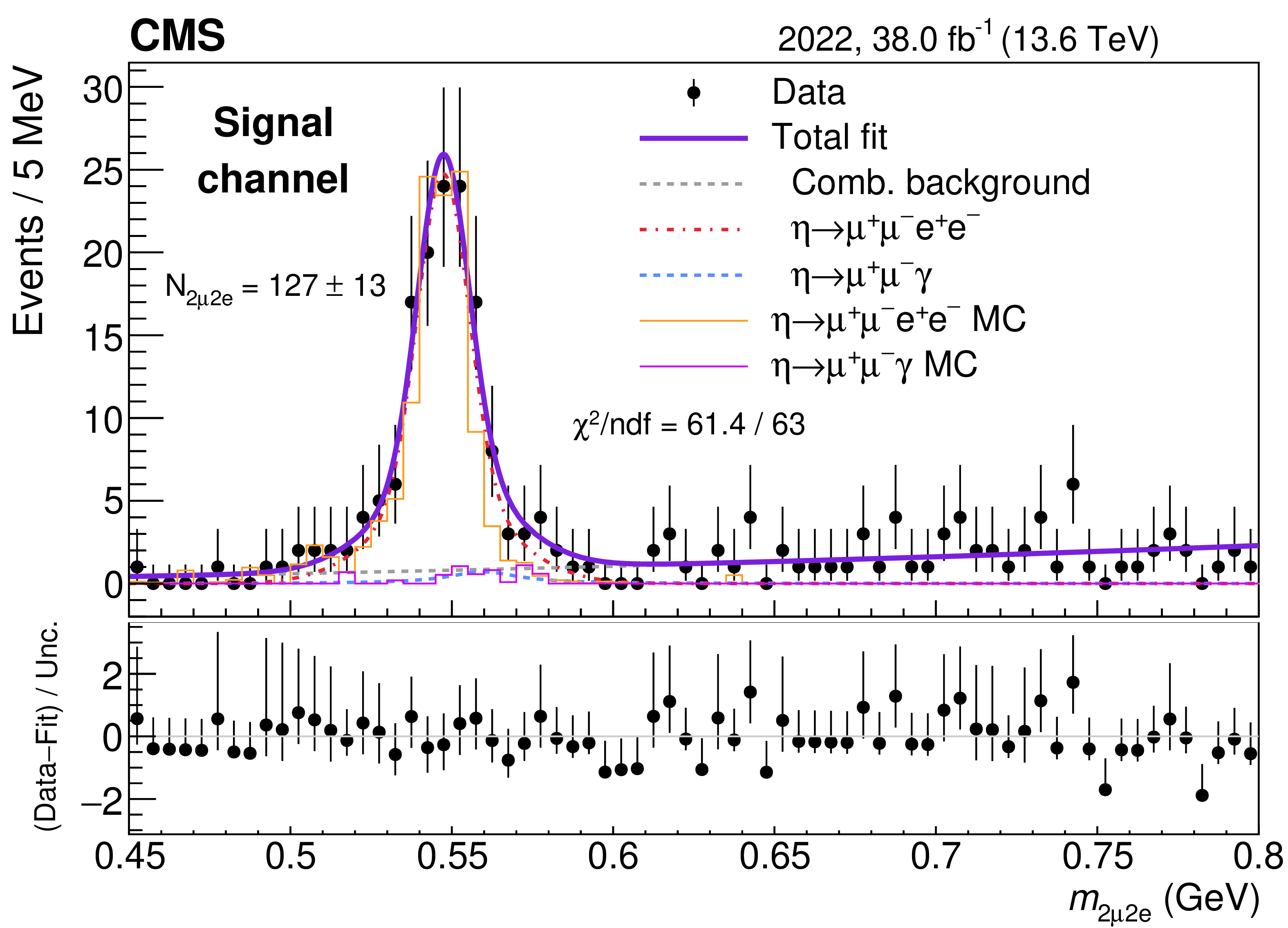
Above: Histogram of the invariant mass of the four leptons (two muons and two electrons), in data (black points) with a fit (blue-violet curve), including a signal component of the fit (red dotted curve) and a background component (grey dotted curve). Also shown is the prediction for the signal shape from simulation (orange line). The bump at the η meson mass of 0.55 GeV is extremely clear.
The study measured the fraction of η meson decays into a muon pair and an electron pair to be about 2.4 per million decays, with an uncertainty of roughly 33%. This result agrees with the predictions of the Standard Model, although the relatively large uncertainty leaves room for a considerably more precise measurement. That more precise measurement could be made in the next few years with more data from LHC Run 3, and with improvements to the way CMS reconstructs low-energy electrons from detector data.
Written by: Bennett Greenberg, for the CMS Collaboration
Edited by: Muhammad Ansar Iqbal
Read more about these results:
-
CMS Publication (BPH-24-001): "Observation of the rare decay η→μ+μ−e+e−"
-
@CMSExperiment on social media: Bluesky - Facebook - Instagram - LinkedIn - TikTok - Twitter/X - YouTube