
The CMS Collaboration has completed the most precise measurement to date of top-quark production in association with a photon
Using the full Run 2 dataset of the LHC and advanced machine learning techniques, the CMS Collaboration has delivered the most precise measurement to date of top quark production in association with a photon. In these events, a top quark – the heaviest known elementary particle – is produced in a proton–proton collision along with a particle of light. Although such processes are rare, they provide a uniquely clean way to probe how the top quark interacts with the electromagnetic force.
The top quark has a mass more than 170 times that of the proton, placing it at the heart of the mechanism that gives particles their mass. As a result, the top quark is especially sensitive to possible effects from physics beyond the standard model. When a photon is emitted directly from a top quark, the process provides direct access to the top–photon coupling – a fundamental interaction predicted with high precision by theory. Any deviation from these predictions could point to new particles or previously unknown forces.
At the Large Hadron Collider, top quarks are largely produced either in pairs or individually. In both cases, an additional photon can be radiated, leading to two related but distinct processes: the production of a top quark–antiquark pair with a photon (ttγ), and the production of a single top quark with a photon (tγq), as illustrated in Fig. 1. While both processes have been studied before, they were typically measured separately.
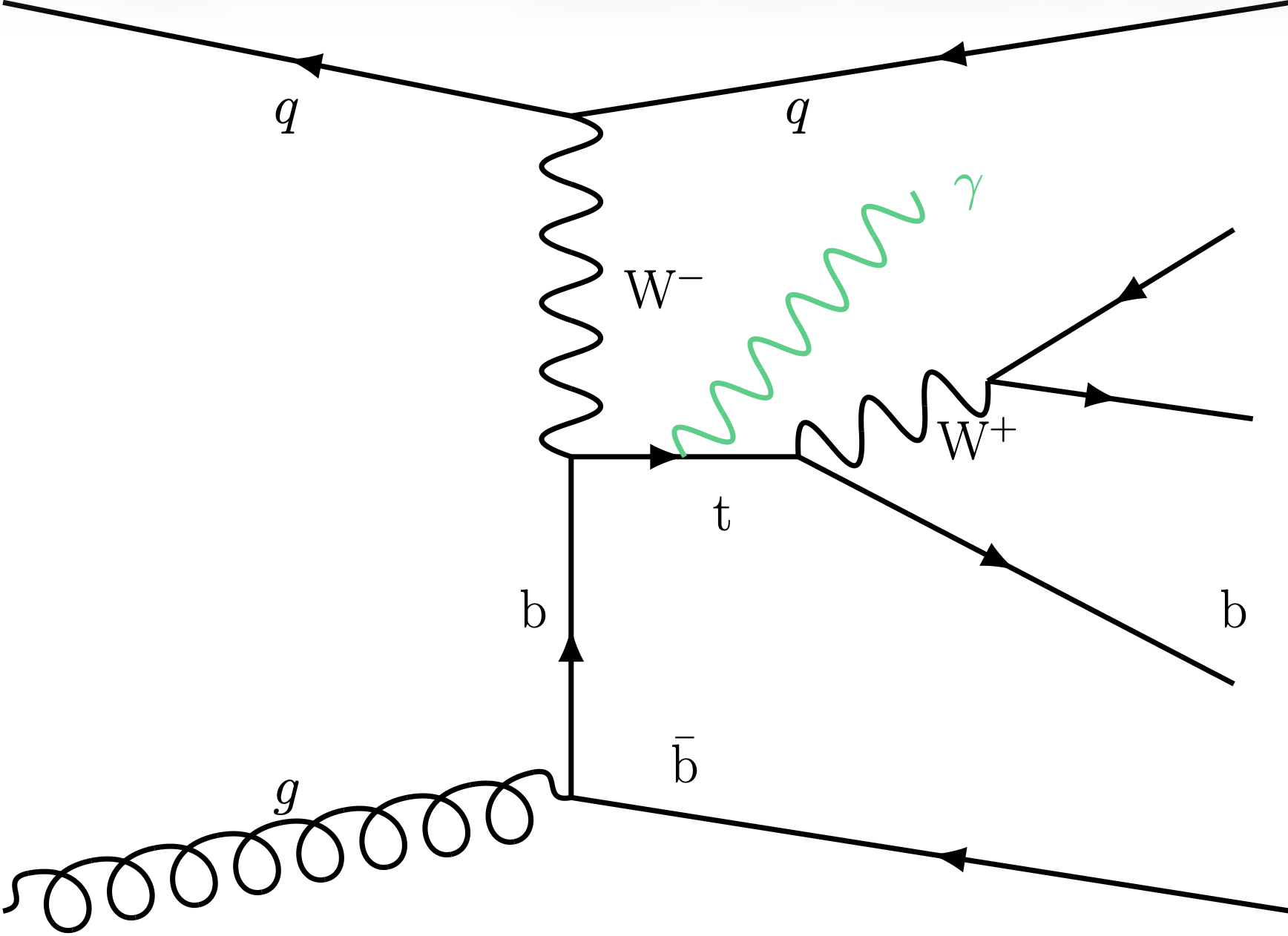
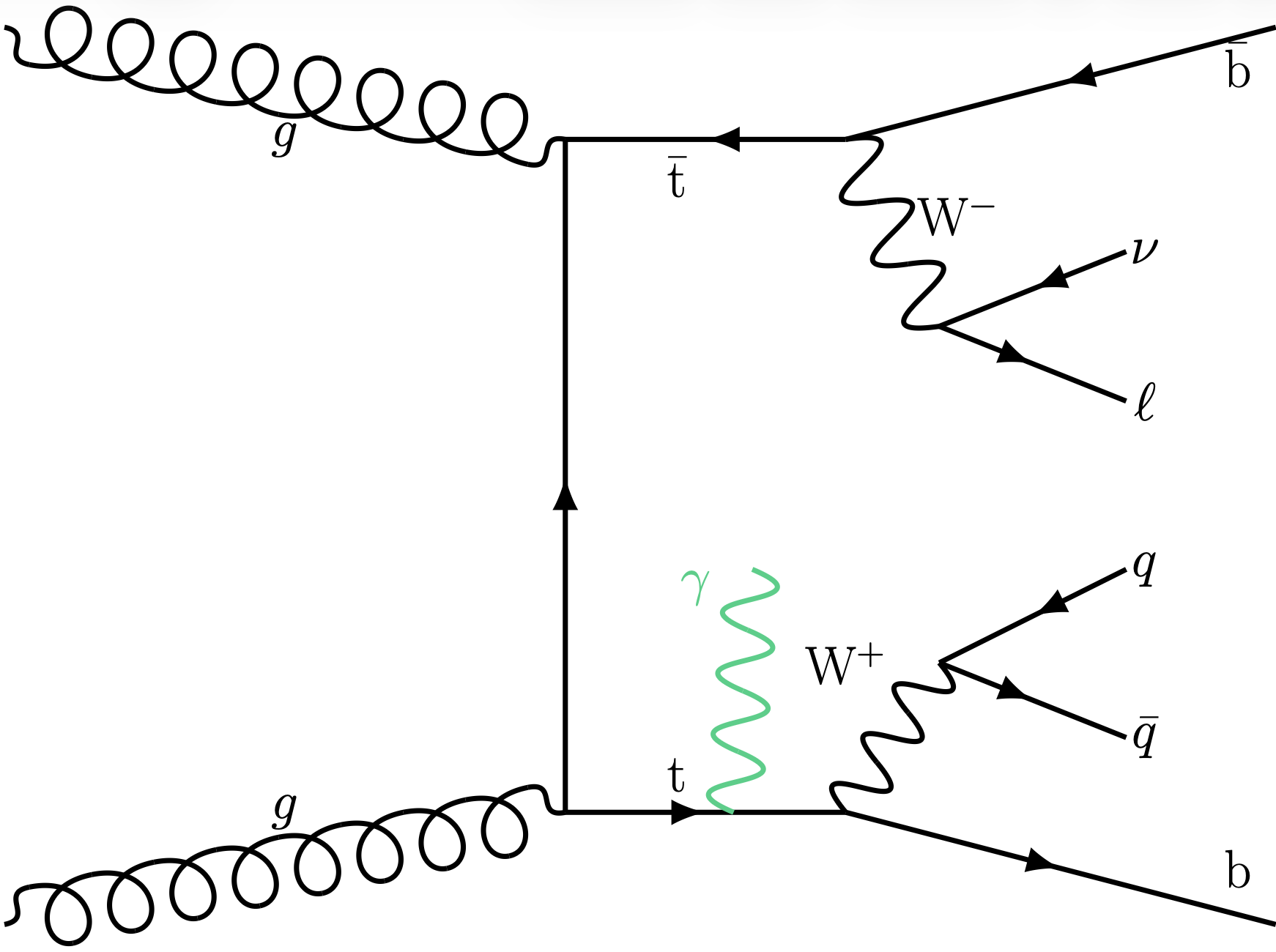
Figure 1: Schematic drawing of single top quark plus photon (tγq) and top quark-antiquark plus photon (ttγ) production on the left and right, respectively. The photon can be emitted directly from the top quark (as shown in green), probing the top–photon interaction.
In this analysis, CMS performed the first simultaneous measurement of both processes in a single global fit, enabling the two signals to be disentangled in a consistent and statistically optimal manner. Because ttγ and tγq events can closely resemble each other, separating them is a major experimental challenge. The analysis focuses on events containing a high-energy electron or muon, an isolated photon, and jets originating from quarks. To distinguish between the two production modes and suppress backgrounds, the team employed a boosted decision tree – a machine learning algorithm that combines many kinematic features of each event into a single powerful discriminator.
“Fitting the single-top and top-pair photon processes simultaneously gives us a much cleaner and more precise probe of the top–photon interaction,” says Ying AN, postdoctoral researcher from the DESY CMS group and main author of the analysis. “It allows us to control correlated uncertainties and directly measure how the two production modes interplay in data.”
The measured production rates for both processes are in excellent agreement with standard model predictions. Beyond measuring overall production rates, the analysis also determined how these processes depend on key kinematic properties, such as the momentum of the photon and the angular separation between the top quark and the photon. These differential measurements are particularly sensitive to subtle quantum effects and provide valuable input for future interpretations in terms of effective field theories that describe possible new physics.
Although no deviation from the standard model is observed, the improved precision places significantly stronger constraints on scenarios in which the electromagnetic interactions of the top quark are modified. With the larger datasets from Run 3 and the upcoming High-Luminosity LHC, even more stringent tests of the top quark’s properties will become possible, further sharpening one of the most sensitive probes of physics at the highest energy scales.
Written by: Ying AN, for the CMS Collaboration
Edited by: Andrés G. Delannoy
Read more about these results:
-
CMS Physics Analysis Summary (TOP-25-003): "Measurement of single top quark and t t̄ production cross sections in association with a photon in proton-proton collisions at √s = 13 TeV"
-
@CMSExperiment on social media: Bluesky - Facebook - Twitter - Instagram - LinkedIn - TikTok - YouTube