
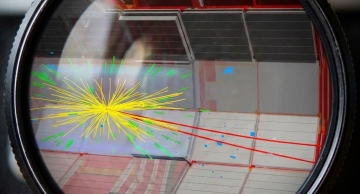
The CMS experiment presents the first measurement of ϒ mesons – bound states of a bottom quark-antiquark pair – in oxygen-oxygen and neon-neon collisions, and strongly indicates that their production is suppressed owing to quark-gluon plasma…

CMS observes collective motion of particles in light-ion collisions, providing robust evidence of how initial nuclear geometry maps to final-state flow.
For the first time, the CMS experiment has measured how particles flow in collisions of…

The CMS experiment has analyzed the first-ever neon-neon collisions, looking for signs of quark-gluon plasma. By comparing these results with data from oxygen-oxygen, xenon-xenon, and lead-lead collisions, physicists find an interesting…
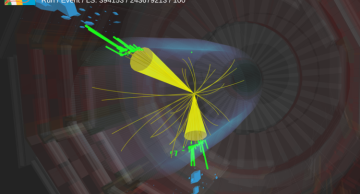
CMS scientists study the first-ever oxygen-oxygen collisions at the LHC, and observe signs of quarks and gluons losing energy when they travel through quark-gluon plasma – a state that existed just after the Big Bang.
When heavy ions such as…
This year, the LHC is colliding more than protons and lead ions: oxygen and neon have also made it into the collider, and are being studied by CMS and the other LHC experiments in order to understand the early universe!
This is the first time that…