
CMS observes collective motion of particles in light-ion collisions, providing robust evidence of how initial nuclear geometry maps to final-state flow.
For the first time, the CMS experiment has measured how particles flow in collisions of…


The CMS experiment has analyzed the first-ever neon-neon collisions, looking for signs of quark-gluon plasma. By comparing these results with data from oxygen-oxygen, xenon-xenon, and lead-lead collisions, physicists find an interesting…
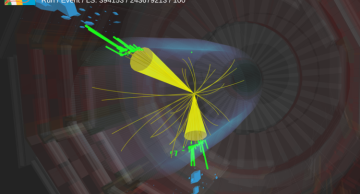
CMS scientists study the first-ever oxygen-oxygen collisions at the LHC, and observe signs of quarks and gluons losing energy when they travel through quark-gluon plasma – a state that existed just after the Big Bang.
When heavy ions such as…
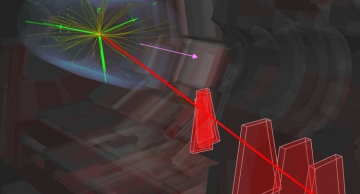
CMS presents the most precise measurement of WWZ production to date by combining Run 2 data with more recent Run 3 data.
The electroweak interaction provides a unified description of the electromagnetic and weak forces, but this symmetry is broken…

Going back to the origins, in a latest result, the CMS experiment rediscovers the Higgs boson and measures its rate of production in the "golden channel", now at the unprecedented centre-of-mass energy of 13.6 TeV.
The discovery of the Higgs…

In a recent result, the CMS experiment measures the production of charmed D0 mesons in collisions of a photon with a heavy lead nucleus for the first time.
Atomic nuclei are made up of protons and neutrons, which in turn are made up of more…
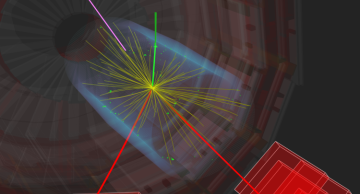
Our current understanding of the nature of elementary particles and their interactions is encapsulated in what is known as the Standard Model (SM) of particle physics. Particles and interactions introduced in the SM have been measured with…

In 2012, the discovery of the Higgs boson marked a milestone in particle physics. It validated the standard model (SM) and unlocked new avenues of exploration. In 2022, the Higgs boson turned ten and the CMS experiment now presents a new…

The discovery of the Higgs boson represents a significant breakthrough in understanding the universe’s fundamental structure and dynamics. Despite this achievement, numerous profound mysteries persist, namely what is the nature of dark matter, why…
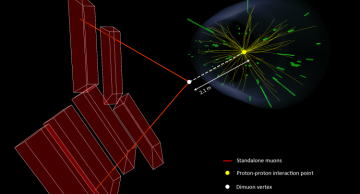
The first search for new physics using LHC data collected in Run 3 has been presented by CMS. It was shown during this year’s EPS conference in Hamburg and relied on both the new data and refinements of the trigger system made for Run 3. It…
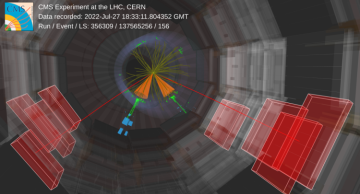
On 5 July 2022, the LHC surpassed the previous energy limits of experimental particle physics, breaking its own record by achieving stable proton-proton collisions at a center-of-mass energy of √s = 13.6 TeV. This marked the start of Run 3, the…