
Originally posted on the September EP Newsletter
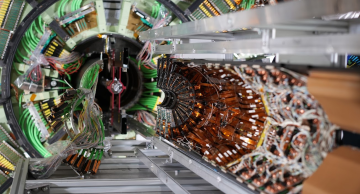
The CMS detector still looks familiar, but empty racks and cable trays reveal that its Phase-2 transformation has begun. Removing around 600 m³ of legacy services safely, traceably and without…
News
|
sohurst |
Detector
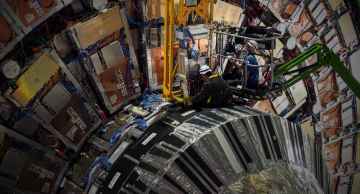
The core of the CMS experiment, the tracker pixel detector, has been removed after a decade of successful operation.
Acting as the detector’s innermost tracker, it recorded signals left by charged particles, enabling scientists to reconstruct…
|
sohurst |
Detector
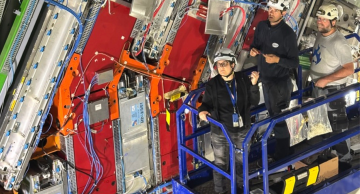
How do you install new, additional components in an already compact machine? CMS Cathode Strip Chamber (CSC) muon detectors are being removed to make way for major upgrades, before returning to their place in the experiment’s transformed…
|
sohurst |
Detector
After years of effort to imagine, design, develop, build, and coordinate, a new chapter for the CMS Drift Tubes has finally begun!
Commissioning of the CMS DT system for the High-Luminosity LHC upgrade is officially underway. The DTs are gas-…

|
sohurst |
Detector
One of the largest structures of CMS's future High Granularity Calorimeter (HGCAL) has successfully completed a demanding series of cold tests, marking an important milestone on the road to the High-Luminosity LHC and the next era of particle…

|
sohurst |
Detector
29th of June 2026 saw the end of the LHC Run 3, and the end of the LHC as we know it! The next time CMS records particle collisions, it will be in 2030, provided by the HL-LHC, and from a very different detector to what we have today.
CMSers…

|
sohurst |
Detector
The Electromagnetic Calorimeter (ECAL) group has tested the second enfourneur (pictured above), a highly specialized instrument that allows the insertion and extraction of key components of the CMS detector at CERN, the ECAL ‘supermodules’.
Weighing…

|
sohurst |
Detector
CMS successfully carried out key tests for the lifting system needed in the construction of Hi Lumi CMS during the end of year stop 2025/2026.
Four thin legs emerge from the floor of the CMS cavern to lift incredibly heavy parts of the CMS detector…

|
nstathak |
Detector
After an eight-week journey, the first HGCAL absorber structure (CE-H1) was delivered to CERN and is ready to be assembled, just 100 metres above where the detector will eventually be located.
Seventeen enormous boxes were delivered at the CMS…

|
sohurst |
Detector
The increase in data processing capabilities means that CMS is one step closer to being ready for Run 4.
The new Data Acquisition (DAQ) room is a state-of-the-art server room, essential for the Hi-Lumi phase of the detector and beyond. New server…

|
sohurst |
Detector
New BRIL subsystems illuminate CMS’s path through Run 3
After many months of meticulous preparations, new BRIL subsystems were installed in mid-January. The intervention will ensure that CMS can continue to achieve world leading accuracy in its…

|
sohurst |
Detector
The TBPS Rings are in production, offering an innovative design to incline sensors toward the LHC beam and maximise coverage. They are the first support structures in production for the new Tracker!
As part of the CMS Hi-Lumi Tracker, construction…