
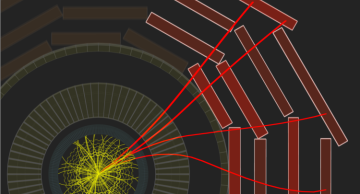
The J/ψ meson, a remarkable particle simultaneously discovered by two independent experiments in 1974, has a unique place in the world of experimental particle physics. By revealing the existence of an extra “flavour” of quarks, it…

If you have ever had Neapolitan gelato, you know how important it is to combine three different flavours, each in just the right size. And the Standard Model (SM) of particle physics is not less tasty than that! In the SM, leptons are some of the…
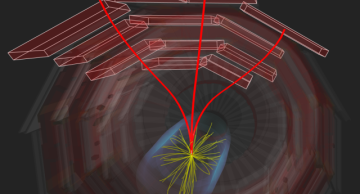
It was 1918 when the mathematician Emmy Noether published what is known as her most famous theorem, revealing the fundamental relation between the symmetries of a physical system and the laws enforcing the conservation of some of its characteristic…
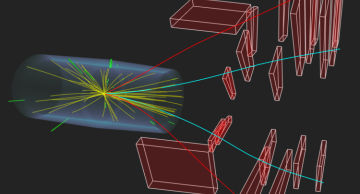
For over two millennia, people have wondered about the diversity of the material world, asking questions like “what are things made of?”. In the early decades of the 20th century we figured out that all things are composed of electrons, protons…
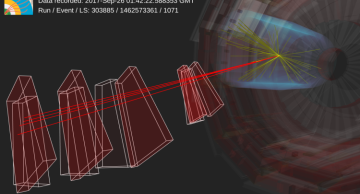
The amount of data that CMS has collected so far is truly astounding, thanks to the very large number of proton-proton collisions that the LHC has provided, over more than a decade, and to the large rate of events that CMS can record. And yet, even…
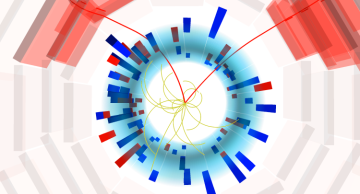
Rare events, such as a total solar eclipse or a supernova explosion, are fascinating and stimulate our imagination. In addition, such events may lead to discoveries expanding our knowledge horizon. At the Large Hadron Collider (LHC), studies of…
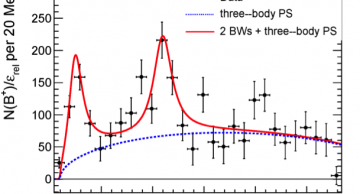
In the vast particle landscape, there are, to borrow a phrase, known knowns (the Standard Model, for example), unknown unknowns (exotic extensions of the Standard Model and beyond), and those ever-interesting known unknowns. A recent CMS observation…

CMS observes the η meson decaying into two muons and two charged pions for the first time.
Over the past three years, the CMS experiment has steadily expanded our view of the eta (η) meson's rarest decays. Following the first observations of the η…