

The CMS experiment achieves the most precise determination of the strength of the strong nuclear force using the rates of production of jets at several centre-of-mass energies.
The strengths of the fundamental interactions in Nature drive the…
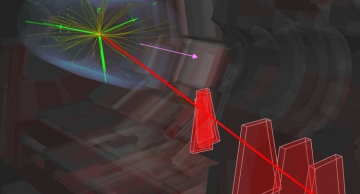
CMS presents the most precise measurement of WWZ production to date by combining Run 2 data with more recent Run 3 data.
The electroweak interaction provides a unified description of the electromagnetic and weak forces, but this symmetry is broken…
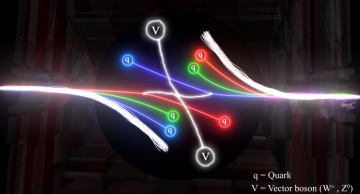
The CMS experiment performs a combined measurement of the scattering of W and Z bosons in the several possible final states, improving over the precision of each individual result.
When the Large Hadron Collider started taking data in 2008,…

In an extraordinary feat of precision physics, CMS measures the mass of the W boson, and finds it to be in good agreement with the prediction by the Standard Model of particle physics.
In the most precise measurement of its kind ever obtained at the…
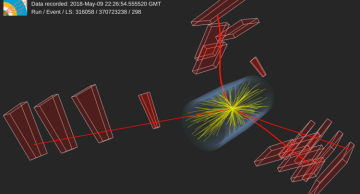
The CMS Collaboration at CERN has conducted an analysis to explore the differences between tau leptons and muons, the two heavier cousins of the electron, and both also fundamental particles in the Standard Model (SM) of particle physics.…
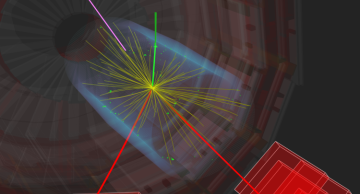
Our current understanding of the nature of elementary particles and their interactions is encapsulated in what is known as the Standard Model (SM) of particle physics. Particles and interactions introduced in the SM have been measured with…
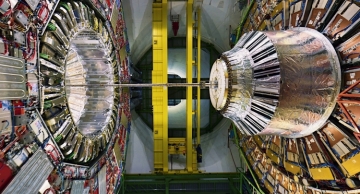
A fundamental parameter of the Standard Model, the electroweak mixing angle plays a key role in the “Higgs mechanism”, when the W and Z gauge bosons get their masses through electroweak symmetry breaking. CMS has now reported a new measurement of…
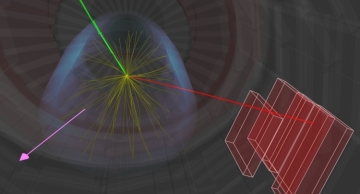
Even if the standard model of particle physics (SM) describes Nature incredibly well, it fails in providing insight to a number of observations such as the existence of dark matter. How do we get a better (and bigger) model than the SM? From the…
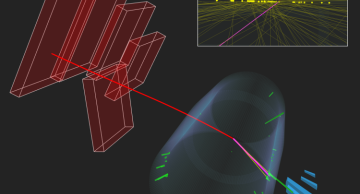
In quantum electrodynamics (QED), the quantum theory of electromagnetic interactions, the magnetic dipole moment of a particle acquires quantum corrections originating from interactions with virtual photons and other particles, often referred to as…
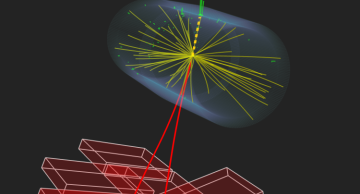
A proton-proton collision at a centre-of-mass energy of 13 TeV, recorded by CMS, compatible with the production of a Higgs boson decaying to a J/ψ meson, which decays to two muons (red lines), and a high-energy photon (green box, top). Try to zoom…
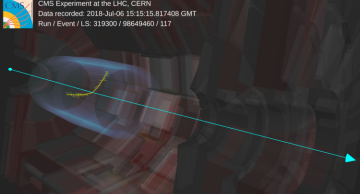
At the subatomic level, interactions between particles are mediated through the exchange of special particles, the force carriers. In the case of electromagnetism, the force is transmitted by photons. They connect particles with electric charge (…
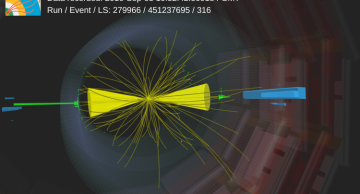
Among all the elementary particles, quarks and gluons (partons) are the only ones that cannot be observed in isolation. In high-energy collisions, such as those occurring at the Large Hadron Collider (LHC), partons undergo a few stages between their…